

A bank that receives a compliant presentation under a documentary letter of credit (DLC) has one job: pay. But what happens when sanctions enter the picture? The bank must determine whether it is legally prohibited from paying, entitled to withhold payment under a contractual sanctions clause, or obliged to pay notwithstanding its internal risk assessment. Get it wrong in one direction and the bank risks regulatory penalty; get it wrong in the other and it risks civil liability for wrongful refusal.
The answer is not one-size-fits-all. The degree of discretion available to a bank depends on the nature of the obligation it has assumed – and a confirmed letter of credit, which is an irrevocable undertaking to pay against compliant documents, sits at the most constrained end of the spectrum. The question is: where exactly does the line fall?
Two recent decisions from the United Kingdom Supreme Court and the Singapore Court of Appeal answer that question with unusual clarity. While neither is binding in New Zealand, both are highly instructive. Together, they establish when a bank is required to withhold payment, when it is entitled to do so, and when refusal crosses into overreach. This article examines both decisions and their implications for banks navigating sanctions risk in the DLC context.
Who needs to read this and why?
This alert is primarily relevant to in-house counsel, compliance professionals and risk managers at banks and financial institutions involved in trade finance. It will also interest lawyers advising on documentary credit disputes and sanctions compliance, and exporters and importers navigating sanctions risk in cross-border supply chains.
Reading this alert will assist banks and their advisers to understand the legal framework governing payment decisions under DLCs where sanctions concerns arise, and to manage the resulting compliance and litigation risk.
Documentary letters of credit
DLCs are mechanisms for managing commercial uncertainty in the supply of goods, particularly in international trade. They provide sellers with payment certainty and buyers with delivery assurance by interposing a financial institution as a reliable intermediary.
A defining feature of DLCs is the principle of autonomy[1] : the bank's payment obligation is independent of the underlying sale or financing contract and is triggered by the presentation of compliant documents, not by performance of the underlying transaction.
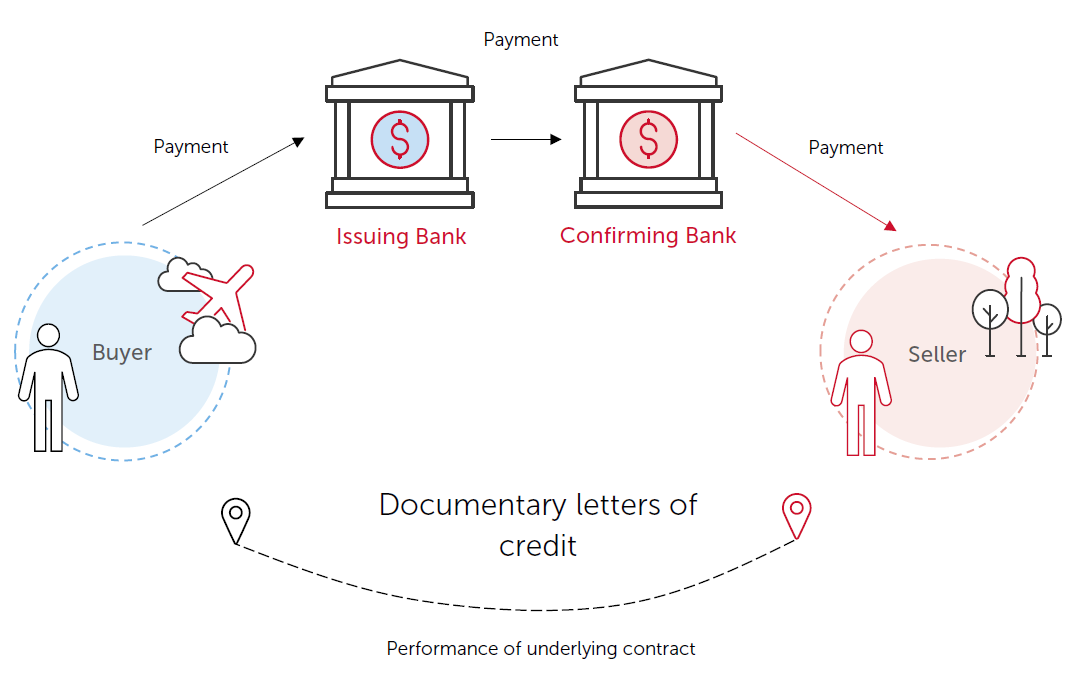
The mechanics of a typical DLC transaction are illustrated in Figure 1 below:
-
The buyer applies to its bank (the issuing bank) for a DLC in favour of the seller.
-
The issuing bank and buyer agree the DLC terms, including the documents the seller must present to trigger payment (e.g. bills of lading, certificates of quality and insurance, and potentially a sanctions clause).
-
The issuing bank asks a bank in the seller's jurisdiction (the confirming bank) to add its confirmation and advise the credit to the seller.
-
The confirming bank advises the DLC to the seller, creating a separate and independent payment obligation owed directly to the seller.
-
The seller ships the goods and presents the required documents. If they comply strictly with the DLC terms, the confirming bank must pay.
-
The confirming bank is reimbursed by the issuing bank, which recovers from the buyer.
In practice, additional layers - correspondent banks, reimbursement undertakings, currency conversions - mean a sanctions event at any point in the chain can freeze the entire transaction.
Figure 1. Operation of typical DLC
Where DLCs and sanctions compliance collide
The way DLCs operate can sit uncomfortably with sanctions compliance. Sanctions do not automatically excuse payment. Whether non-payment is justified depends on the applicable sanctions legislation, the governing law of the DLC, and any contractual sanctions clause.
Three tensions are particularly acute:
-
Wider context matters: The principle of autonomy is not absolute in a sanctions context. A bank cannot disregard the broader commercial arrangement a DLC supports, especially where sanctions red flags are provided within the DLC documentation.
-
Documentary compliance does not relieve sanctions duties: DLCs demand documentary compliance rather than actual delivery. Sanctions compliance may require banks to look beyond the documents where such indicators are present.
-
Certainty is qualified: The certainty a DLC is intended to provide can be disrupted by sanctions compliance, as payment may need to be delayed or refused where the bank can establish a lawful basis for doing so.
Two international cases, one clear message
Two recent decisions from the UK and Singapore bring this tension into sharp focus. While reaching different outcomes on the facts, both courts drew the same boundary between lawful refusal and overreach.
UK Supreme Court – UniCredit
In UniCredit Bank GmbH v Celestial Aviation Services Ltd [2026] UKSC 10, the UK Supreme Court considered whether UK sanctions prohibited a confirming bank from paying under standby letters of credit issued to secure aircraft leases to Russian airlines.
The letters of credit and underlying leases pre-dated the sanctions regime. Following Russia's invasion of Ukraine in February 2022, the UK amended regulation 28(3)(c) of the Russia (Sanctions) (EU Exit) Regulations 2019 to prohibit the provision of funds "in pursuance of or in connection with" arrangements whose object or effect was making restricted goods (including aircraft) available to persons connected with Russia. The lessors terminated the leases and made compliant demands. The bank refused to pay, contending that the prohibition applied.
The lessors argued that a causative link between the bank's payment and the continued availability of aircraft in Russia was required. The Court rejected that argument. It held that "in connection with" was deliberately broader than "in pursuance of" and required only a factual connection between the provision of funds and the relevant arrangement - not a causal one. The letters of credit were factually connected to the aircraft leases, and the leases were arrangements whose object was making aircraft available to persons connected with Russia. The termination of the leases did not retrospectively alter that object. Accordingly, the Court held that the bank was prohibited from paying under the letters of credit until licences were obtained, and its payment obligation was suspended for the duration of the prohibition.
The judgement acknowledges that this produced a "relatively blunt instrument" – the bank had no obligation to pay, and the beneficiaries had no right to demand payment, for as long as the prohibition remained in force. But the breadth was deliberate: vital public interests were at stake, and the licensing regime operated as a safety valve to mitigate unintended consequences. The arbiter of whether a payment should proceed was the licensing authority, not the bank. A bank facing a prohibition must apply for a licence; it cannot simply refuse to pay and leave the beneficiary without recourse.
Finally, the Court reaffirmed that a bank may refuse payment where it has a reasonable belief that doing so would breach sanctions, under section 44 of the Sanctions and Anti-Money Laundering Act 2018 (SAMLA). This introduces a degree of flexibility into what is otherwise a strict payment obligation under letters of credit. However, that protection is qualified by reasonableness and is temporary: once a licence is granted, the prohibition falls away and a bank’s payment obligation revives.
The judgement further notes that the bank could not rely on US sanctions to excuse delay after UK licences were granted, as it had failed to make reasonable efforts to obtain a US licence in parallel. The practical message is clear: a bank that withholds payment on sanctions grounds must actively pursue the licensing process across all applicable regimes.
Singapore Court of Appeal – Kuvera
In Kuvera Resources Pte Ltd v JPMorgan Chase Bank, N.A. [2023] SGCA 28, the Singapore Court of Appeal addressed the converse situation: a bank relying not on a statutory prohibition, but on a contractual sanctions clause and its own internal risk assessment to refuse payment under confirmed DLCs.
JPMorgan's confirmations contained a sanctions clause providing that it would not be liable for delay or failure to pay where documents were presented "involving any country, entity, vessel or individual listed in or otherwise subject to any applicable restriction". When the beneficiary requested payment, JPMorgan refused on the basis that its internal screening had flagged the carrying vessel - the Omnia - as potentially Syrian-owned. The vessel did not appear on any published list maintained by the US Office of Foreign Assets Control (OFAC).
The Court held that the sanctions clause had to be construed objectively. The question was whether the vessel was in fact "subject to any applicable restriction" – not whether OFAC might have found a breach, and not whether the bank's risk-based preference to be sued by the beneficiary rather than penalised by OFAC was rational. The Court rejected the approach adopted by the High Court at first instance, which had accepted that it sufficed for JPMorgan to show that OFAC would have regarded payment as a violation. That approach introduced speculation and arbitrariness: it required the court to extrapolate what a third party not identified in the clause might conclude on largely circumstantial evidence, rendering it impossible for a beneficiary to know with certainty whether it would be paid.
The burden of proving that the vessel was subject to an applicable restriction rested squarely on JPMorgan. The Court found that the evidence fell well short. By 2019, the vessel's registered owner was a Barbados entity, its technical manager a UAE company, and its managing director a Cypriot national – none bearing any Syrian nexus. JPMorgan's own correspondence with OFAC acknowledged that the evidence of continued Syrian beneficial ownership was "inconclusive". Internal red flags and a preference for false positives over false negatives did not amount to proof on the balance of probabilities.
The Court, in obiter provoked that “… the question of whether sanctions clauses are incompatible with the nature of irrevocable documentary credit transactions remains an open and difficult one, and for good reason.”
Despite this, the decision draws a clear line: where a sanctions clause is invoked, the bank must establish by admissible evidence that the transaction actually falls within the scope of an applicable restriction. Subjective risk appetite, internal screening lists, and inconclusive due diligence are insufficient to override the certainty that a confirmed DLC is designed to provide.
Our view
Together, these decisions reflect a coherent approach across two distinct scenarios:
-
Where a statutory prohibition applies, as in UniCredit: The bank is required to withhold payment, and the payment obligation is suspended until a licence is obtained.
-
Where no statutory prohibition applies and the bank relies on a contractual sanctions clause, as in Kuvera: It must establish by objective evidence that the transaction falls within the scope of an applicable restriction.
In neither case may a bank use broad internal risk appetite as a proxy for legal obligation. Sanctions are a force of law and will override an obligation to pay DLCs where they apply; but a sanctions clause does not, of itself, remove the bank's undertaking.
If presented with similar scenarios, we consider New Zealand courts would adopt a similar approach. The principles applied in both decisions – the autonomy and irrevocability of documentary credits, the objective standard for invoking sanctions-based defences, and the requirement that any discretion afforded by a sanctions clause must not undermine the commercial purpose of the instrument – are consistent with established documentary credit law and sanctions compliance obligations applicable in this jurisdiction.
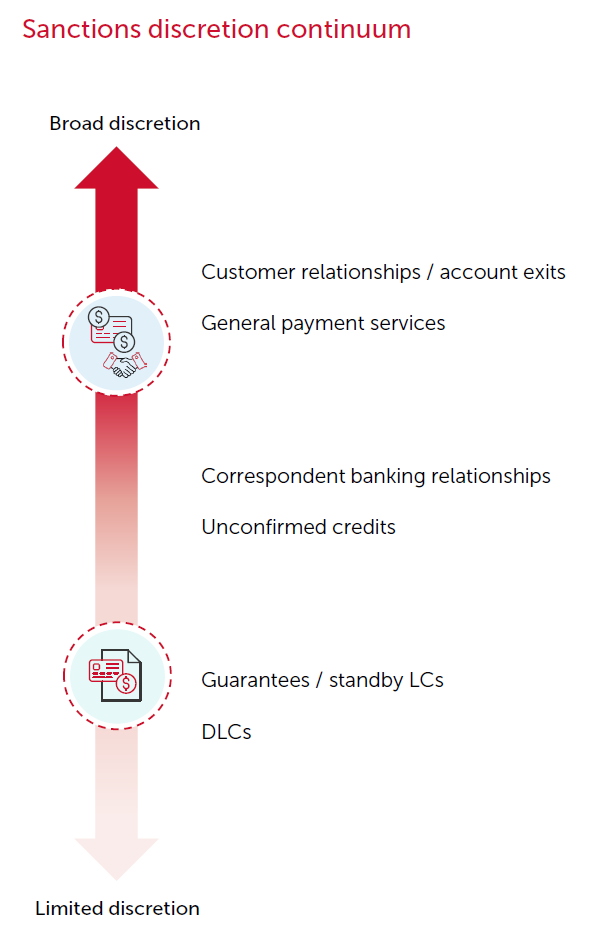
Figure 2 illustrates the spectrum of sanctions-related discretion available to banks, demonstrating that the extent of permissible judgment varies according to the nature of the obligation undertaken:
At one end of the spectrum, decisions such as whether to de-bank a customer or decline to provide general payment services are typically governed by broad, risk-based discretion. In this context, banks may take a holistic view of sanctions exposure, reputational risk, and internal compliance policies, subject to any applicable contractual or regulatory constraints.
At the opposite end, a confirmed DLC allows for markedly less discretion. By confirming the credit, the bank undertakes a primary and autonomous obligation to honour a complying presentation. The commercial function of that undertaking is to provide certainty of payment, independent of the underlying transaction, thereby significantly constraining the bank’s ability to withhold performance based on discretionary or internal risk assessments.
Between these poles sit a range of intermediary instruments and arrangements, such as unconfirmed credits, collections, and correspondent banking relationships – where the degree of discretion is more nuanced. In these cases, banks retain some latitude to respond to sanctions concerns, but that discretion is increasingly shaped, and in some instances limited, by the specific legal and commercial commitments they have assumed.
The central implication is that sanctions compliance cannot be approached as a uniform exercise. Rather, banks must calibrate their response to the precise nature of the instrument and the corresponding legal obligation, recognising that the scope for discretion narrows as the bank’s commitment becomes more definite and payment-focused.
Figure 2. Bank’s ability to exercise sanctions-related discretion
Recommendations for banks
For banks, the practical implications are clear.
-
When a sanctions red flag is evident in a DLC presented for payment, investigate carefully and document all enquires noting any decision to refuse payment must be based on reasonable evidence of sanctions based illegality.
-
When a statutory prohibition applies, the bank's obligation is suspended by operation of law and the appropriate course of action may be to apply for a licence to enable payment. Internal risk appetite should not be treated as equivalent to a legal prohibition.
-
When reviewing or proposing a sanctions clause, ensure that its drafting is precise and consistent with the underlying commercial instrument, avoiding provisions that would undermine the autonomy or irrevocable nature of DLC payment obligations, and recognising that applicable sanctions laws will operate as mandatory rules irrespective of contractual wording.
-
Implement robust compliance processes and early risk identification given the time-sensitive nature of DLCs. Treat sanctions compliance as operating on an instrument-dependent continuum, rather than applying a uniform approach across all financial services.
How we can help
MinterEllisonRuddWatts has extensive experience advising financial institutions on sanctions compliance, documentary credit law, and cross-border trade risk. Whether you are reviewing DLC sanctions clauses, assessing whether a payment obligation is prohibited, or strengthening your sanctions compliance framework, our team can help.
Footnote:
[1] Reflected in Article 4 of UCP 600.
This article was co-authored by Isabelle Pou (Law Clerk), in our Corporate team.